

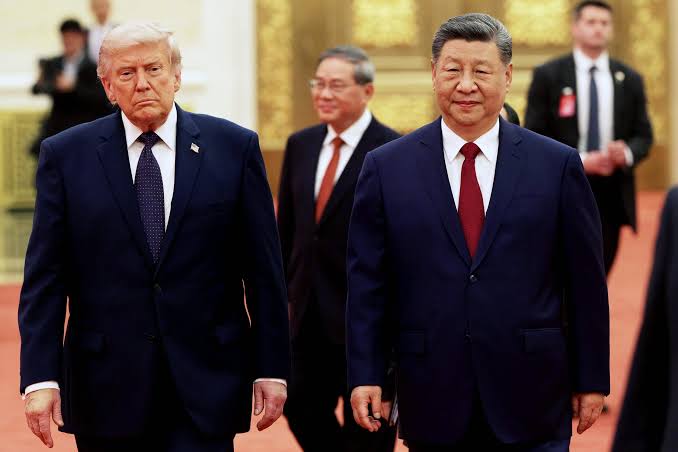
U.S. President Donald Trump is set to continue Chinese President Xi Jinping’s Washington visit with a tour of the National Archives after talks covering trade, artificial intelligence, Taiwan and broader U.S.-China relations.
Trump Xi Summit Continues With National Archives Visit
The Trump Xi summit in Washington is moving into another stage as U.S. President Donald Trump prepares to continue Chinese President Xi Jinping’s visit with a tour of the U.S. National Archives on Friday.
The visit follows high-level discussions between the two leaders on trade, artificial intelligence, Taiwan and other major issues affecting relations between the United States and China.
What happened during the Trump Xi summit?
U.S. President Donald Trump and Chinese President Xi Jinping met at the White House on Thursday for talks focused on the relationship between the world’s two largest economies.
The meeting came during a period of significant competition between Washington and Beijing over trade, technology, artificial intelligence and regional security.
According to Reuters, the summit produced no major breakthrough on several of the most difficult disputes between the two countries. However, the two sides agreed to extend their existing trade truce by two months, giving negotiators additional time to work toward a broader agreement.
The extension is significant because the United States and China have spent much of the past several years negotiating over tariffs, market access, technology restrictions and other economic issues.
For businesses and investors, avoiding an immediate escalation provides additional time for both governments to negotiate.
Trade remains at the center of U.S.-China relations
Trade was one of the most important subjects surrounding the Trump Xi summit.
Washington and Beijing have previously imposed tariffs and other restrictions on each other’s goods, creating uncertainty for companies operating across the two markets.
The latest extension of the trade truce is intended to give both sides more time to negotiate.
Reuters reported that the agreement extends the current arrangement until January 10.
The agreement does not resolve the broader trade relationship between the United States and China.
Questions remain over tariffs, market access, agricultural products, technology and China’s role in global supply chains.
The two governments will now have additional time to discuss those issues before the extended deadline.
Artificial intelligence becomes another major issue
Artificial intelligence was also an important part of the discussions.
The United States and China are competing for leadership in advanced technologies, including artificial intelligence, semiconductors and computing infrastructure.
Both governments have introduced policies aimed at protecting strategic technologies and national security interests.
At the same time, the rapid development of AI has created areas where the two countries could potentially communicate and cooperate.
Technology companies are closely watching the relationship because restrictions involving advanced chips, AI systems and computing equipment can have consequences far beyond the United States and China.
The outcome of future negotiations could therefore affect businesses, investors and the wider technology industry.
Taiwan remains one of the biggest disagreements
Taiwan remains another major issue between Washington and Beijing.
China claims Taiwan as part of its territory, while Taiwan’s government rejects Beijing’s sovereignty claims.
The United States does not have formal diplomatic relations with Taiwan but maintains extensive unofficial relations and provides support for the island’s self-defense.
During the summit, Xi Jinping pressed the United States over Beijing’s position on Taiwan, according to reporting from Reuters.
The issue remains particularly sensitive because Beijing has repeatedly opposed U.S. arms sales and other forms of American support for Taiwan.
For Washington, maintaining its long-standing policy toward Taiwan remains an important part of its relationship with Beijing.
This means Taiwan is likely to remain a major subject in future U.S.-China discussions.
Trump and Xi continue their public engagement
The two leaders are continuing their engagement after Thursday’s White House summit.
On Friday, Trump is scheduled to accompany Xi to the U.S. National Archives.
The visit has a strong symbolic element.
Trump has said the leaders will see important American historical documents, including the Declaration of Independence, the U.S. Constitution and the Bill of Rights.
The visit also comes as both governments attempt to present continued dialogue between Washington and Beijing.
Reuters described Thursday’s summit as heavy on ceremony and symbolism, with limited evidence of major breakthroughs on the deepest disagreements between the two countries.
Why the Trump Xi summit matters
The relationship between the United States and China affects much more than the two countries themselves.
Together, the two economies have a major influence on global trade, technology, manufacturing and financial markets.
Changes in tariffs can affect companies and consumers.
Restrictions on advanced technology can influence the global semiconductor and AI industries.
Tensions over Taiwan can affect security calculations across Asia and beyond.
That is why even relatively limited agreements between Washington and Beijing can attract significant international attention.
The extension of the trade truce gives both sides more time to negotiate rather than immediately returning to a higher level of economic confrontation.
However, the agreement does not eliminate the underlying disputes.
What happens next?
The immediate focus will be on whether Washington and Beijing can turn the latest discussions into longer-term agreements.
Trade negotiations are expected to continue, while artificial intelligence, technology restrictions and Taiwan will remain difficult issues.
The Trump Xi summit has therefore produced continued diplomatic engagement, but the biggest questions between the two governments remain unresolved.
For now, the extended trade truce provides additional time for negotiations.
The coming months will show whether that additional time leads to a broader agreement or simply delays another round of tensions between Washington and Beijing.


Leave a Reply