

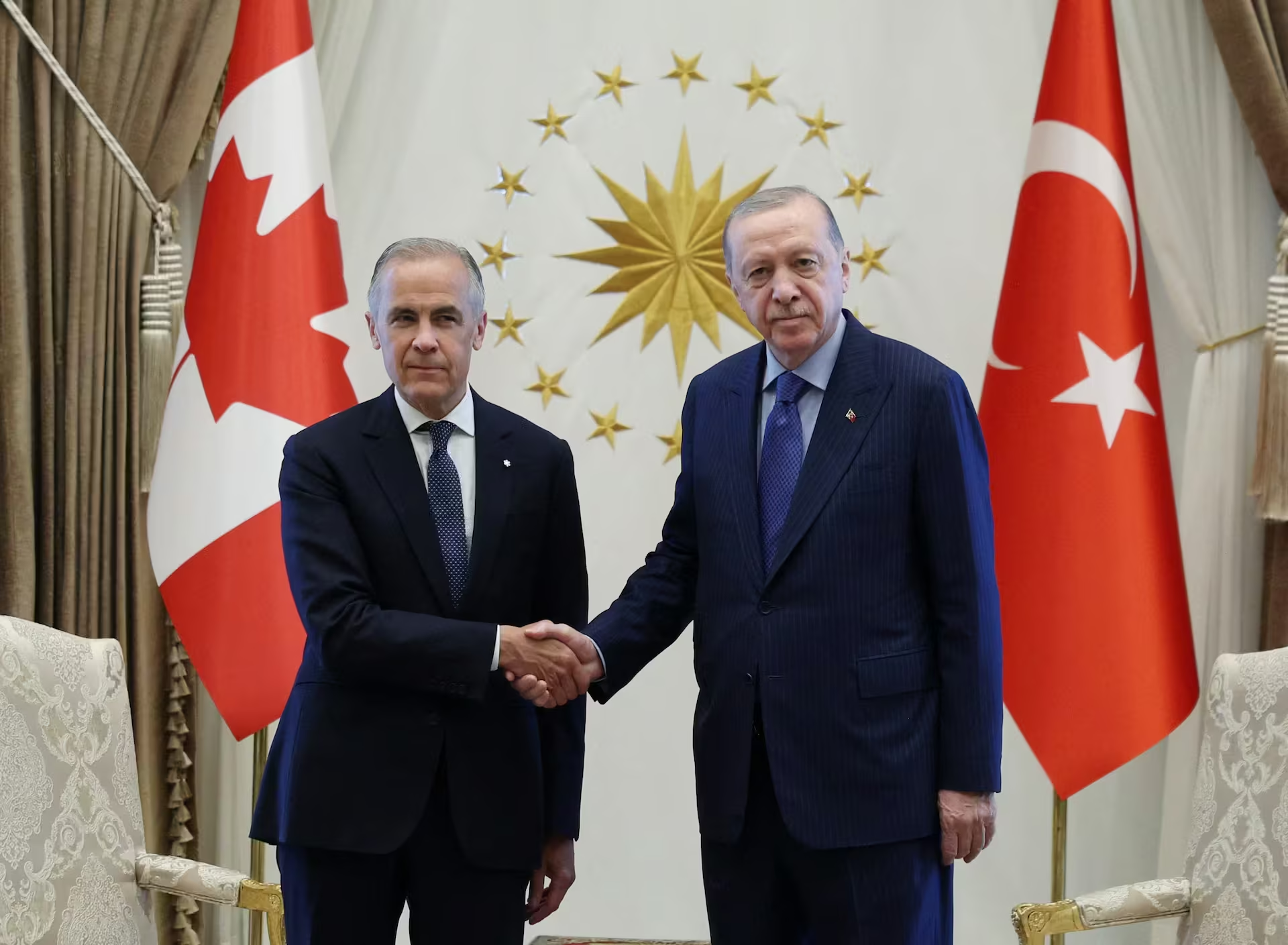
ANKARA, October 23, 2026 — Canada and Turkey have upgraded their relationship to a strategic partnership, expanding cooperation on trade, investment, defence, energy and transport as Canadian Prime Minister Mark Carney seeks to diversify his country’s international economic ties.
Carney and Turkish President Recep Tayyip Erdoğan announced the partnership during the Canadian prime minister’s visit to Ankara on October 22. The two NATO allies signed cooperation agreements covering energy, defence and air transport and agreed to begin negotiations on a free-trade agreement.
The announcement comes at a time of trade tensions between Canada and the United States, Canada’s largest trading partner. Carney’s government has been pursuing new economic relationships in an effort to increase Canadian exports to markets beyond the United States.
The partnership sets an ambition to raise bilateral trade toward $10 billion, although reaching that target will require further negotiations, investment and commercial activity.
A broader economic strategy for Canada
The partnership with Turkey is part of Carney’s wider effort to expand Canada’s economic options. Ottawa has argued that relying too heavily on a single export market leaves Canadian businesses exposed to changes in trade policy and economic conditions.
The United States remains central to Canada’s economy, and the new partnership does not replace that relationship. Instead, the Canadian government is seeking additional markets and investment opportunities that could help Canadian businesses reach more customers internationally.
Turkey offers access to a large domestic market and a strategic position connecting Europe, the Middle East and Asia. Its membership in NATO also provides an established framework for security cooperation with Canada.
For Ottawa, the potential benefits include new opportunities for exporters, industrial partnerships and investment in sectors where both countries have strategic interests.
Defence and security cooperation
Defence is one of the partnership’s central areas. Both countries are NATO members, and the new arrangements are intended to deepen cooperation between their industries and governments.
Turkey has developed a substantial defence sector, including capabilities in drones, aerospace and naval systems. Canada has expertise in aerospace, engineering and advanced industrial technologies.
Closer cooperation could create opportunities for companies in both countries, although the scale and timing of specific projects will depend on subsequent agreements, regulatory requirements and commercial decisions.
The announcement should not be interpreted as confirmation of a major weapons contract or a new joint military operation. The reported agreements establish a framework for cooperation; individual projects would require further details.
Energy and investment opportunities
Energy is another important part of the relationship. The two countries are exploring cooperation in areas that include nuclear energy, liquefied natural gas and critical minerals.
Turkey has ambitions to expand its energy infrastructure and is seeking international partners for future projects. Canadian companies may be able to contribute expertise in engineering, nuclear technology, resource development and energy systems.
However, discussions about potential cooperation are not the same as a final investment decision. Project financing, technical reviews, regulatory approval and commercial negotiations will determine whether proposals move forward.
The partnership could therefore open doors for Canadian businesses, but the eventual economic impact remains to be seen.
A free-trade agreement is not yet complete
Carney and Erdoğan have agreed to start negotiations on a free-trade agreement. Such a deal could eventually reduce trade barriers and establish clearer rules for businesses operating in both markets.
Negotiations can take time, particularly when countries need to reconcile different standards, tariffs and regulatory systems. Until a final agreement is negotiated and implemented, businesses cannot assume that the proposed deal will automatically reduce their costs.
The two governments have also discussed the goal of increasing bilateral trade toward $10 billion. That is an objective for future growth, not the current value of trade.
What it means for relations with Washington
The timing of the announcement is significant because Canada is seeking to reduce its vulnerability to trade disputes with the United States. President Donald Trump’s tariff policies and public disagreements with Ottawa have encouraged Canadian officials to look for ways to strengthen economic relationships elsewhere.
Nevertheless, Canada and the United States remain closely connected through supply chains, investment, manufacturing and cross-border commerce. Building new partnerships is a diversification strategy, not evidence that Canada can quickly replace the U.S. market.
The Carney government will need to demonstrate that its international agreements translate into new export orders, investment and long-term employment.
What happens next?
The next stage will involve putting the strategic partnership into practice. Officials and businesses will need to identify projects, develop action plans and advance the proposed free-trade negotiations.
The clearest immediate outcome is a formal commitment to deepen Canada-Turkey relations across several sectors. The larger economic results will depend on what both countries negotiate and implement over the coming months and years.
For Canada, the initiative reflects an effort to broaden its international options during a period of trade uncertainty. For Turkey, it offers a chance to attract investment and expand cooperation with a fellow NATO member.
The partnership marks a new diplomatic and economic direction — but its real significance will be measured by the deals and investment that follow.
Sources: Reuters and The Associated Press, reporting published October 22–23, 2026.
Leave a Reply