


The president’s latest remarks come as American forces acknowledge additional limited strikes near Iran’s Qeshm Island and diplomatic efforts continue over the future of the conflict.
Trump Says U.S. Could Become an “Occupier” in Iran as He Claims Control of Strait of Hormuz
U.S. President Donald Trump has suggested that Washington could assume an occupying role in Iran, while claiming that American forces control the strategically important Strait of Hormuz.
The remarks, delivered to reporters in Florida on Friday, November 6, add another layer of uncertainty to the conflict between Washington and Tehran, which has entered its ninth month.
“All we are is maybe an occupier. We could be an occupier,” Trump said when discussing America’s involvement in the confrontation with Iran.
His comments attracted attention because they appeared to leave open the possibility of a broader American role beyond the military operations and naval pressure already underway.
Trump did not provide details about what he meant by an occupying role, how such an arrangement might work, or whether the administration was considering a formal occupation of Iranian territory.
Trump claims the United States controls the Strait of Hormuz
The president also repeated his assertion that the United States controls the Strait of Hormuz, a narrow maritime passage connecting the Persian Gulf with the Gulf of Oman.
“We control the Hormuz Strait,” Trump told reporters.
He also claimed that the United States was taking out more oil through the waterway than at any time in its history.
The strait is one of the most important energy routes in the world. Large volumes of internationally traded oil and other energy supplies normally pass through it, making any disruption a major concern for global markets.
However, Trump’s statement about American control is disputed.
Iran has rejected Washington’s assertion and maintains that Tehran retains strategic control over the waterway. Iranian officials have also insisted that reopening the passage depends on conditions set by Iran.
The competing claims highlight the unresolved dispute over maritime access, military presence and control of shipping in the Gulf.
Trump acknowledges additional limited strikes near Qeshm Island
During the same exchange with reporters, Trump was asked about reports of new American military activity near Iran’s Qeshm Island.
He initially declined to discuss the operation but later acknowledged that the United States was conducting what he described as “minor strikes.”
Trump said Iranian forces had established an anti-aircraft installation that American forces destroyed within minutes.
The remarks follow the administration’s earlier confirmation of limited strikes against an Iranian air-defense system near Qeshm Island.
The island is strategically important because of its location near the Strait of Hormuz.
The Associated Press reported that the latest military action came as Iran’s leadership was reviewing diplomatic proposals mediated by Qatar to bridge differences with Washington.
The reported proposals involve the U.S. blockade of Iranian ports, frozen Iranian funds, international inspections of nuclear facilities and the possible reopening of the Strait of Hormuz.
No final agreement has been announced.
Iran rejects Washington’s claims
Tehran continues to reject the American position regarding the Strait of Hormuz.
Iranian officials argue that the waterway remains under their strategic control and that the United States cannot unilaterally determine the conditions under which commercial vessels pass through it.
The dispute is particularly significant for international energy markets.
Any prolonged restriction on shipping through Hormuz could affect oil supplies, transportation costs and fuel prices in countries far beyond the Middle East.
For Washington, maintaining pressure on Iran while protecting international shipping remains a major strategic challenge.
A military confrontation and diplomatic efforts continue simultaneously
Trump’s latest remarks come at a time when military operations and diplomatic contacts are continuing in parallel.
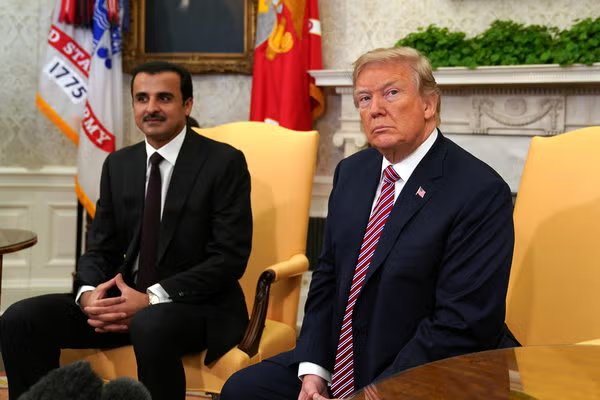
Qatar has been working to mediate between the United States and Iran, with discussions reportedly covering nuclear inspections, sanctions, frozen assets and the future of the maritime blockade.
The two sides have not reached a comprehensive settlement, and important disagreements remain.
Trump’s suggestion that the United States could become an occupying power adds uncertainty to the administration’s longer-term objectives.
However, his statement does not establish that Washington has decided to occupy Iran or that a formal occupation plan exists.
For now, the central questions remain whether negotiations can produce an agreement, whether the Strait of Hormuz can return to normal commercial traffic, and whether the military confrontation will escalate further.
The future of the conflict could have consequences well beyond Iran and the United States, particularly for global energy supplies, regional security and the wider international economy.
SOURCES
- Anadolu Agency — Trump says US ‘could be an occupier’ in Iran
- Associated Press — US military carries out new targeted strikes on Iran as Tehran’s leaders weigh mediator’s proposals
- Aaj English TV — Trump says US could become ‘occupier’ in Iran
Leave a Reply