

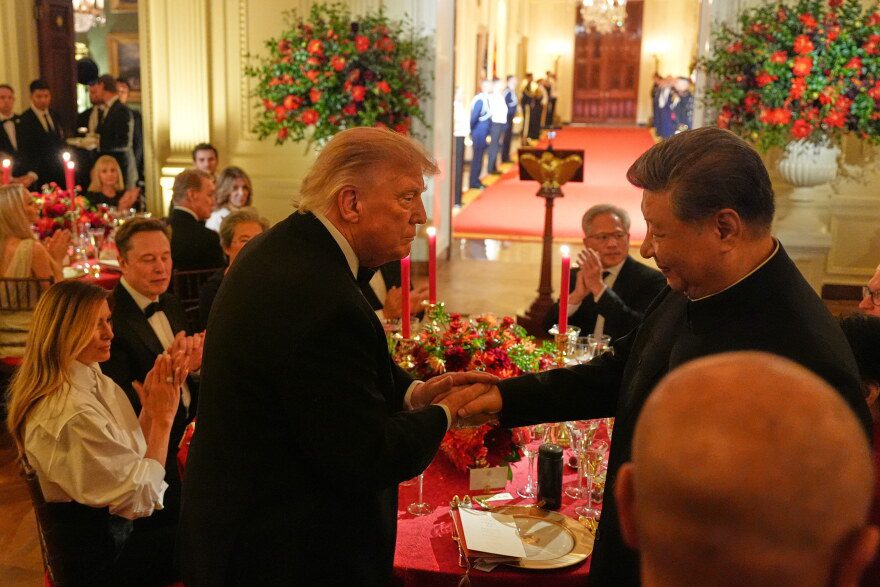
Donald Trump hosted Chinese President Xi Jinping for a state dinner in Washington after their summit, with trade, AI and Taiwan remaining central to the U.S.-China relationship.
Trump and Xi’s White House Dinner Highlights Closer Engagement as Major Disputes Remain
U.S. President Donald Trump hosted Chinese President Xi Jinping for a formal state dinner at the White House on Thursday, September 24, following a high-profile summit between the two leaders.
The dinner brought together senior figures from U.S. politics, business and technology as Washington and Beijing continued efforts to manage their increasingly important relationship.
Among the prominent guests were NVIDIA CEO Jensen Huang and Apple chairman Tim Cook, according to Reuters. The presence of major technology executives was notable given the growing importance of artificial intelligence and advanced technology in U.S.-China relations.
A highly symbolic evening
The state dinner followed a day of formal meetings and ceremonies at the White House.
Trump and Xi used the visit to emphasize continued communication between Washington and Beijing, even as the two governments remain divided over several major issues.
Reuters described the summit as heavy on symbolism but without major breakthroughs on some of the most difficult disputes between the two countries.
The dinner nevertheless provided another public display of engagement between the two leaders.
Trade truce extended
One of the clearest economic outcomes from the summit was an extension of the existing U.S.-China trade truce.
According to Reuters, the agreement was extended by two months, giving both governments additional time to continue negotiations.
The extension matters because the United States and China remain deeply connected through global trade and supply chains.
Companies in both countries have been closely watching the negotiations because changes in tariffs and trade restrictions can affect manufacturing, prices and investment decisions.
However, the extension does not resolve the broader economic disagreements between Washington and Beijing.
AI and technology move closer to the center
Artificial intelligence was another major issue surrounding the Trump-Xi discussions.
The United States and China are competing for leadership in AI, semiconductors and advanced computing.
The presence of technology leaders at the state dinner highlighted how closely the private technology sector is connected to the broader geopolitical relationship.
NVIDIA’s Jensen Huang and Apple’s Tim Cook were among the high-profile American executives invited to the event.
The technology relationship remains complicated, however, with Washington and Beijing maintaining different approaches to advanced technology, national security and access to critical computing resources.
Taiwan remains unresolved
Taiwan remains one of the most sensitive issues in U.S.-China relations.
Beijing claims Taiwan as part of China, while Taiwan’s government rejects Beijing’s sovereignty claims.
The United States maintains unofficial relations with Taiwan and provides defensive support to the island.
Xi raised Taiwan during his discussions with Trump, and the issue remains a major point of disagreement between Washington and Beijing.
The summit did not produce a major breakthrough on Taiwan, according to Reuters.
The dinner was more than a diplomatic photo opportunity
The guest list itself offered an important glimpse into the economic dimension of the relationship.
With major American technology executives attending alongside the two leaders, the dinner brought geopolitics and corporate interests into the same room.
That is particularly significant as Washington and Beijing compete over artificial intelligence, semiconductors, supply chains and other strategic technologies.
The United States and China remain economic competitors, but their companies and markets are also deeply connected.
What happens next?
Xi’s three-day U.S. visit continues on Friday, September 25.
The more important test will come after the ceremonies.
The two governments now have additional time to negotiate following the extension of their trade truce.
But major questions remain over tariffs, technology, artificial intelligence and Taiwan.
The state dinner showed Washington and Beijing willing to maintain high-level engagement.
Whether that engagement produces broader agreements remains to be seen.
For now, the image of Trump and Xi sharing a formal dinner at the White House stands alongside a much more complicated reality: the two countries are talking, but their biggest strategic disagreements have not disappeared.
Leave a Reply