

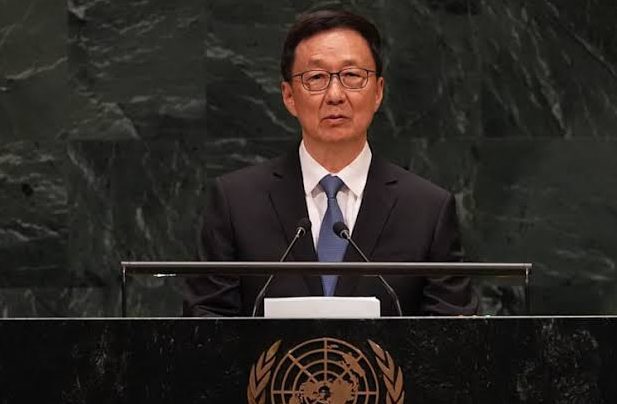
Beijing challenged Washington’s policies toward Iran and Cuba at the United Nations, just one day after Trump and Xi held high-level talks in Washington.
China Pushes Back Against U.S. on Iran and Cuba at UN
Beijing challenged Washington’s policies toward Iran and Cuba at the United Nations, just one day after Trump and Xi held high-level talks in Washington.
China used the United Nations General Assembly on Saturday to push back against several elements of U.S. foreign policy, calling for respect for the sovereignty of Gulf countries and urging Washington to stop threatening Cuba.
Chinese Vice President Han Zheng delivered Beijing’s message as world leaders gathered in New York for the annual UN General Assembly.
China challenges U.S. position on Iran
Iran was one of the most important issues in China’s address.
Beijing called for respect for the sovereignty of countries in the Gulf and opposed unilateral military action.
The position comes as the United States remains involved in a major conflict with Iran and as international efforts continue to find a diplomatic path forward.
China has repeatedly called for negotiations and a return to diplomatic mechanisms.
The issue has also become part of the developing relationship between Washington and Beijing.
Reuters reported that during Trump and Xi’s recent Washington summit, Trump made clear that Chinese assistance to Iran would be unacceptable to the United States. U.S. Ambassador to China David Perdue said Washington had warned Beijing against direct or indirect assistance, including intelligence, parts or military equipment.
China’s latest UN statement therefore comes just after the two countries discussed the conflict at the highest level.
Beijing also targets U.S. policy toward Cuba
Cuba was another major focus.
China urged the United States to stop threatening Cuba and lift its blockade of the island.
The comments follow Trump’s strong criticism of the Cuban government during his UN speech earlier this week.
However, on Saturday Trump offered a somewhat different message, saying he expected the United States and Cuba to reach an agreement and that he did not believe military action would be necessary.
The timing matters
China’s UN intervention comes immediately after the Trump-Xi summit in Washington.
The summit produced several areas of cooperation.
China said the two sides agreed on an eight-point set of understandings, including work toward a more stable relationship, cooperation around major international events, and positions concerning Iran and international waterways.
Separately, China said Washington and Beijing had agreed on a $30 billion reciprocal tariff-reduction arrangement and would establish a dialogue on artificial intelligence.
That creates a complicated picture.
The United States and China are finding areas where they can cooperate economically and technologically, while continuing to disagree over major geopolitical questions.
A broader competition over the international order
China’s message at the UN also reflects Beijing’s broader argument that major powers should respect sovereignty and strengthen the UN-centered international system.
For Washington, meanwhile, the Trump administration has pursued a more confrontational approach toward several countries and has argued that U.S. power should be used to advance American interests.
The competing approaches are increasingly visible at the United Nations.
What happens next?
The immediate question is whether the new U.S.–China economic understanding can remain separate from their geopolitical disagreements.
Iran could be an especially important test.
If the conflict continues, Washington will be watching China’s role closely, particularly regarding energy, trade and any potential assistance to Tehran.
Cuba is another potential flashpoint, although Trump’s latest comments suggest Washington may still be looking for a negotiated outcome.
For now, the message from Beijing is clear: economic cooperation with Washington does not mean agreement on America’s broader foreign policy.
And after the Trump-Xi summit, that distinction could become increasingly important.


Leave a Reply