

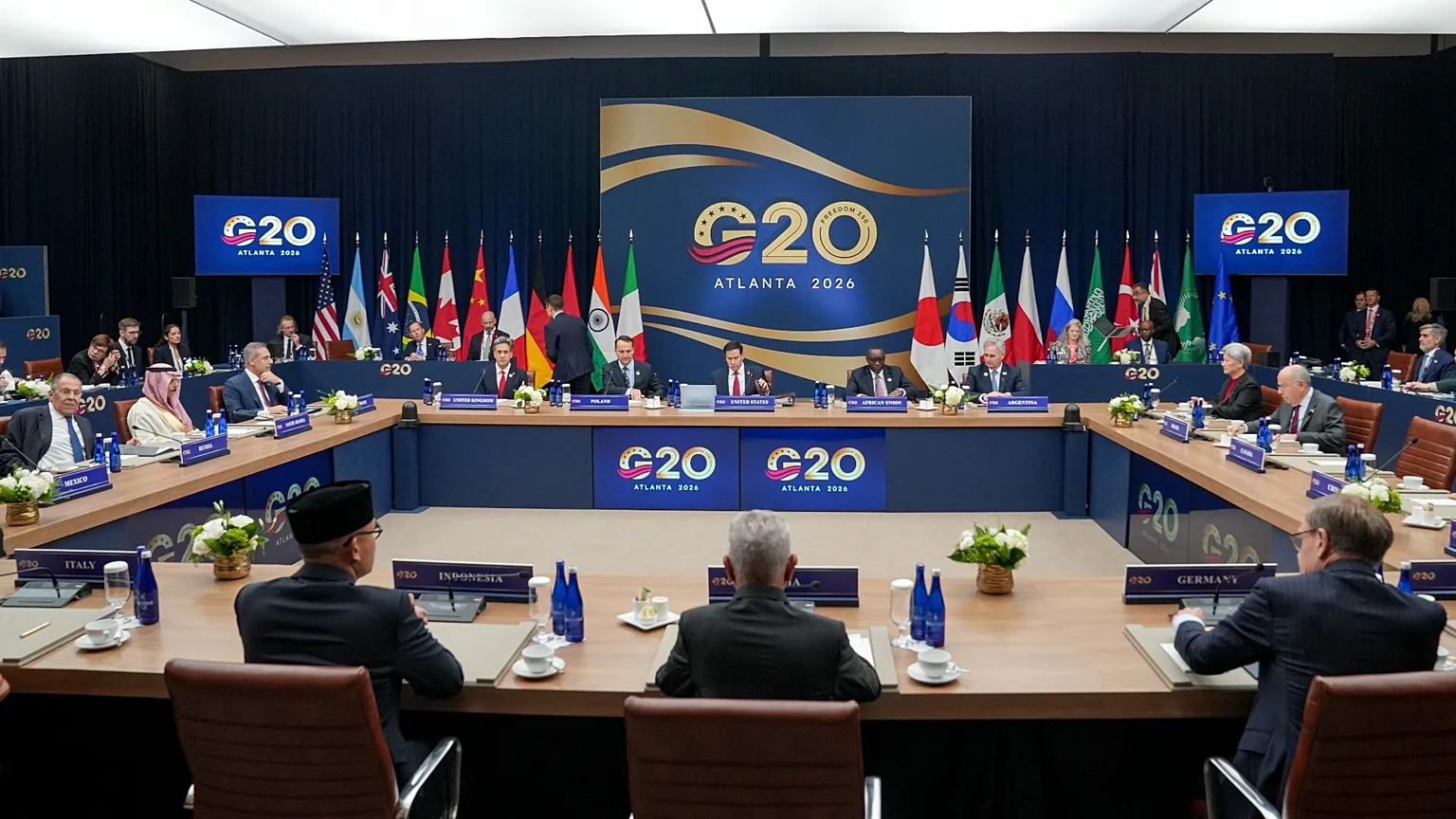
Kaja Kallas accused Moscow of spreading false narratives, while Britain’s Ed Miliband challenged Russia’s position on the war. A diplomatic dispute also led to the cancellation of the traditional G20 group photograph.
European officials used the G20 foreign ministers’ meeting in Atlanta to deliver a direct challenge to Russia over its ongoing war against Ukraine, turning an international diplomatic gathering into a public display of the deep divisions between Moscow and European capitals.
The strongest criticism came from European Union foreign policy chief Kaja Kallas, who accused Russian Foreign Minister Sergey Lavrov of presenting what she described as “a lot of lies” and “false narratives” during discussions about the conflict.
Speaking after the talks, Kallas said European representatives had addressed Lavrov directly on the war and challenged the claims made by the Russian delegation. Her remarks underscored Europe’s position that Moscow’s account of the conflict does not reflect the reality of Russia’s invasion of Ukraine.
Britain’s Foreign Secretary Ed Miliband also confronted Lavrov during the meeting. According to reports, Miliband said the Russian minister should have the courage to tell President Vladimir Putin that Russia would not win the war.
Miliband also raised a recent attack on a railway in Dnipro that reportedly killed 15 people, describing Russia as the aggressor in the conflict.
A dispute over the Black Sea
The discussions were not limited to verbal exchanges. European officials also sought to increase pressure on Moscow to secure a ceasefire in the Black Sea, an important route for agricultural exports.
The security of shipping through the region has broader international consequences, particularly for countries that depend on Ukrainian agricultural products and stable maritime trade.
Lavrov pushed back against the European position. He criticised what he called Europe’s “arrogant boycott” and contrasted it with the Trump administration’s willingness to maintain dialogue with Moscow.
G20 group photograph cancelled
The diplomatic tension became particularly visible when the traditional group photograph of G20 foreign ministers was cancelled.
Several officials reportedly objected to being photographed alongside Lavrov. The decision removed a customary symbolic moment from the gathering and highlighted the continuing diplomatic isolation Russia faces among many Western governments.
The cancellation was not simply a disagreement over protocol. It reflected the political difficulty European officials face in appearing alongside a Russian representative while the war in Ukraine continues.
A divided international forum
The Atlanta meeting took place amid wider disagreements over global security, trade and the conflicts in Ukraine and the Middle East. Although G20 gatherings are intended to provide a platform for cooperation, the discussions exposed how difficult it remains for major powers to find common ground.
For Europe, the message was that diplomatic engagement with Russia cannot be separated from the war in Ukraine and Moscow’s actions on the battlefield.
For Moscow, Lavrov’s participation offered an opportunity to defend Russia’s position and criticise Western pressure.
The confrontation in Atlanta does not signal a breakthrough in negotiations. Instead, it demonstrates that the political gap between Russia and many European governments remains substantial as diplomatic efforts to end the war continue.
Sources: AFP reporting published by Euronews; The Guardian; Deutsche Welle.
Leave a Reply