

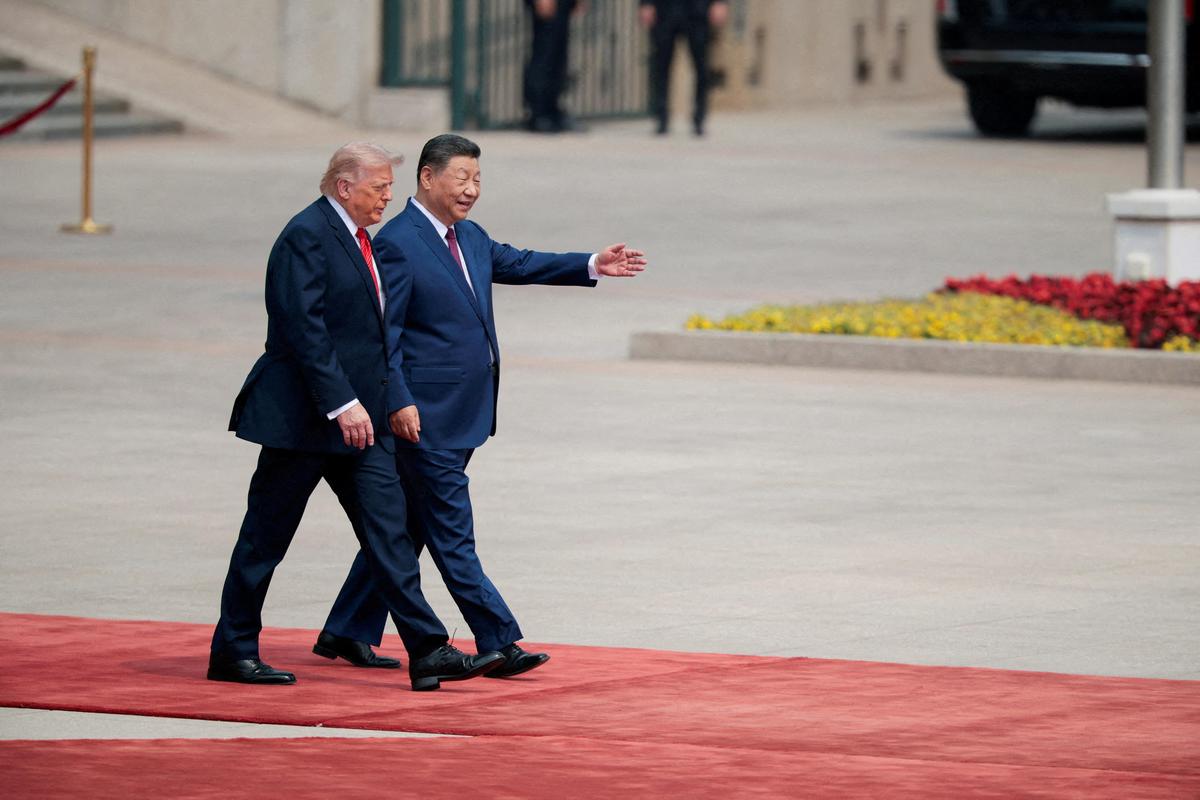
Beijing says the Trump-Xi summit produced an eight-point consensus that includes tariff reductions and a new channel for artificial-intelligence discussions.
The United States and China have agreed on a reported $30 billion reciprocal tariff-reduction arrangement and will establish a new dialogue on artificial intelligence, according to China’s Foreign Ministry.
Trade remains central
Trade has been one of the most difficult issues in the U.S.–China relationship in recent years.
The latest arrangement is intended to reduce some of the tariff pressure between the two countries.
China said the agreement was part of an eight-point consensus reached during Xi’s visit.
The announcement represents a new development after Washington and Beijing had already agreed to extend their existing trade truce.
AI becomes another major issue
Artificial intelligence was also part of the discussions.
The two governments are expected to create a new communication channel focused on AI.
The issue has become increasingly important because AI is now connected to technology competition, national security and economic development.
Washington and Beijing are both investing heavily in AI while competing over advanced computing technology and semiconductors.
Major disagreements remain
Despite the new economic agreement, several disputes remain unresolved.
Taiwan continues to be one of the most sensitive issues.
Technology restrictions, critical minerals and strategic competition also remain major challenges.
The Trump-Xi summit therefore produced new areas of cooperation without eliminating the broader competition between Washington and Beijing.
What happens next?
The key test will be implementation.
If the tariff reductions move forward as announced, companies could gain greater certainty over trade between the two economies.
The new AI dialogue could also create a mechanism for discussing risks and technological competition.


Leave a Reply