

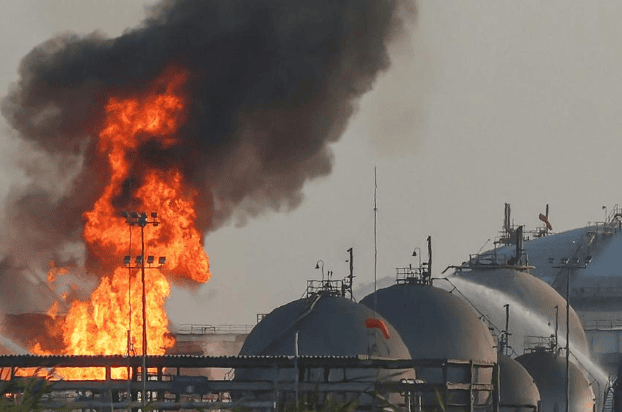
Flames and smoke were seen at the Riyadh refinery on Saturday, deepening a Gulf war that already threatens oil flows.
Flames and smoke rose from a facility belonging to Saudi oil giant Aramco south of Riyadh on Saturday afternoon, according to an Agence France-Presse (AFP) journalist cited by CBS News. The reporter saw firefighters trying to put out a blaze at Aramco’s Riyadh refinery, with ambulances and police vehicles nearby.
The claim. Late on Saturday, Houthi military spokesman Yahya Saree said the Iran-backed group had targeted an oil facility near the Saudi capital with ballistic missiles and drones, adding that the strikes sparked fires. The Houthis said it was retaliation for Saudi attacks on Sanaa and other Yemeni provinces, according to Reuters. Saudi authorities had not commented at the time of writing. Sources familiar with the situation told CBS News that the attack took place but said the Saudis are still assessing who is responsible. The White House and US Central Command did not immediately respond.
Strikes on Sanaa. The Houthi-affiliated Al-Masirah TV reported 26 strikes by “Saudi enemy aircraft” on the Yemeni capital, without details on casualties, and two correspondents in Sanaa reported explosions and warplanes firing missiles. The Houthis also said Saudi Arabia bombed Sanaa on Thursday night, for the first time since renewed fighting began in July.
A widening war. AFP reports that the two sides have traded strikes since the Houthis seized Yemen’s entire Red Sea coast and took control of the Bab el-Mandeb strait in a lightning offensive last month. Yemen returned to civil war in July after a ceasefire that had lasted four years. In July the Houthis announced a maritime blockade of Saudi Arabia, and Aramco sites in Najran and Yanbu were targeted in August and September, according to AFP. The UN population agency says more than 145,000 people have been displaced by the fighting.
Oil angle. Our analysis: the Iran war has already forced Gulf producers to rely on alternative export routes. Maritime data firm Kpler said this week that Persian Gulf exports are near prewar levels, at about 21.8 million barrels a day compared with 23.3 million, using routes that include the Red Sea and Suez Canal. Those routes run past the Yemeni coast now controlled by the Houthis, which is why new strikes on Saudi energy sites worry markets. Washington has sent two more Patriot batteries to Saudi Arabia and Qatar to protect oil and gas sites, according to Axios.
What to watch: official Saudi confirmation, further Houthi strikes, and any impact on oil prices. We will update this article as details emerge.
Related: Tankers attacked again in Hormuz · Oil rises above $105
Sources: CBS News live updates (3 October 2026, ✅ read in full); AFP; Reuters via US News.



Leave a Reply