

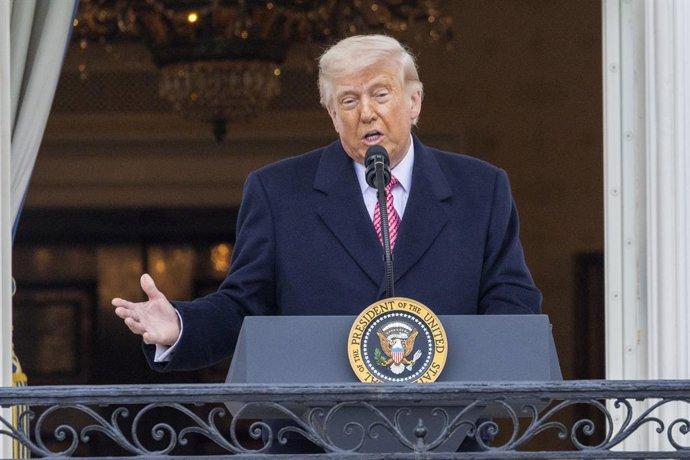
WASHINGTON, October 23, 2026 — President Donald Trump said Friday that the United States could bring its war with Iran to an end quickly, while questioning whether a rapid conclusion would be preferable to allowing the conflict to gradually fade.
The remarks offered a glimpse into the administration’s thinking about how the conflict might end, but did not establish a timetable, announce a peace agreement, or confirm a new military decision.
Speaking to reporters outside the White House before departing for Florida, Trump described a choice between ending the war decisively and allowing it to “wither.” His comments suggested that Washington was considering different paths toward ending the conflict, although he provided limited detail about the conditions that would make either approach possible.
The statements come amid continuing concerns about regional security, shipping through the Strait of Hormuz and the wider economic consequences of the conflict.
Trump signals options but gives few details
Trump presented the United States as having substantial leverage and said the administration was achieving its objectives. He also said oil was continuing to move through the Strait of Hormuz, a strategically important passage connecting the Persian Gulf to international markets.
However, the president did not outline a comprehensive settlement with Tehran or explain whether the two sides had reached an understanding on the main issues separating them.
His remarks should therefore be understood as a statement about possible approaches to ending the war, rather than confirmation that a ceasefire or final agreement is imminent.
The difference matters: an expression of confidence from Washington does not by itself demonstrate that the opposing side has accepted the terms needed to end hostilities.
Why the Strait of Hormuz matters
The Strait of Hormuz is one of the world’s most important energy-shipping routes. Oil and other energy supplies moving through the passage connect producers in the Persian Gulf with customers around the world.
Any prolonged disruption can affect shipping costs, energy markets and broader economic expectations. Even when shipments continue, uncertainty about maritime security can influence the decisions of traders, ship operators, insurers and governments.
That makes the waterway a central part of the conflict’s international impact. The consequences extend beyond the countries directly involved, particularly for economies that depend on imported energy.
Trump’s comments about oil continuing to move through the strait provide the administration’s assessment of the situation, but do not alone establish that maritime risks have disappeared or that normal shipping conditions have fully returned.
The unresolved question of how the war ends
The president’s remarks leave several important questions unanswered. They do not specify what conditions Iran would need to accept, what commitments Washington might offer, or what monitoring arrangements would be required to sustain a settlement.
A durable end to the conflict would depend on more than a public declaration that the war could finish quickly. It would require clarity about the terms, the willingness of the parties to comply, and arrangements to reduce the risk of renewed fighting.
Diplomatic engagement, security guarantees and the future of maritime traffic may all be relevant to any eventual resolution. The precise terms, however, remain unclear from the statements reported Friday.
There is also a distinction between ending active hostilities and resolving the wider disagreements that contributed to the conflict. Even if fighting were to diminish, unresolved security disputes could continue to shape relations between Washington and Tehran.
Global markets and regional security remain exposed
The international stakes are substantial because the conflict touches energy supplies, maritime security and relations among countries across the Middle East.
Governments and businesses will be watching for concrete developments: any formally announced ceasefire, confirmed negotiations, changes in shipping conditions or clearly stated terms for a settlement.
Until such developments are confirmed, Trump’s comments indicate that the administration sees multiple possible paths forward, but they do not establish which path will be chosen or when the war might end.
For now, the Strait of Hormuz remains an important measure of the conflict’s wider effects, while the terms and timing of any eventual end to hostilities remain uncertain.
Source: Reuters, October 23, 2026. Additional context from Anadolu Agency’s reporting on Trump’s comments regarding the possibility of further action against Iran on October 22, 2026.
Read more :Iran Says Strait of Hormuz Could Reopen Within a Week — If the US Accepts Its Conditions


Leave a Reply